

AI Traffic Grew 6.5x Faster Than Human Traffic This Year, Creating New Business Challenges and Opportunities
AI Traffic Grew 6.5x Faster Than Human Traffic This Year, Creating New Business Challenges and Opportunities
New Fastly Research Reveals Rapidly Growing AI Traffic is Reshaping the Internet, Driving Need for Machine Traffic Strategies
SAN FRANCISCO--(BUSINESS WIRE)--Fastly, Inc. (NASDAQ: FSLY), a leading global edge cloud platform, today released new research showing that AI-generated traffic is emerging as a distinct layer of internet activity, requiring organizations to rethink how they manage automated requests, protect infrastructure, and capture value from machine interactions.
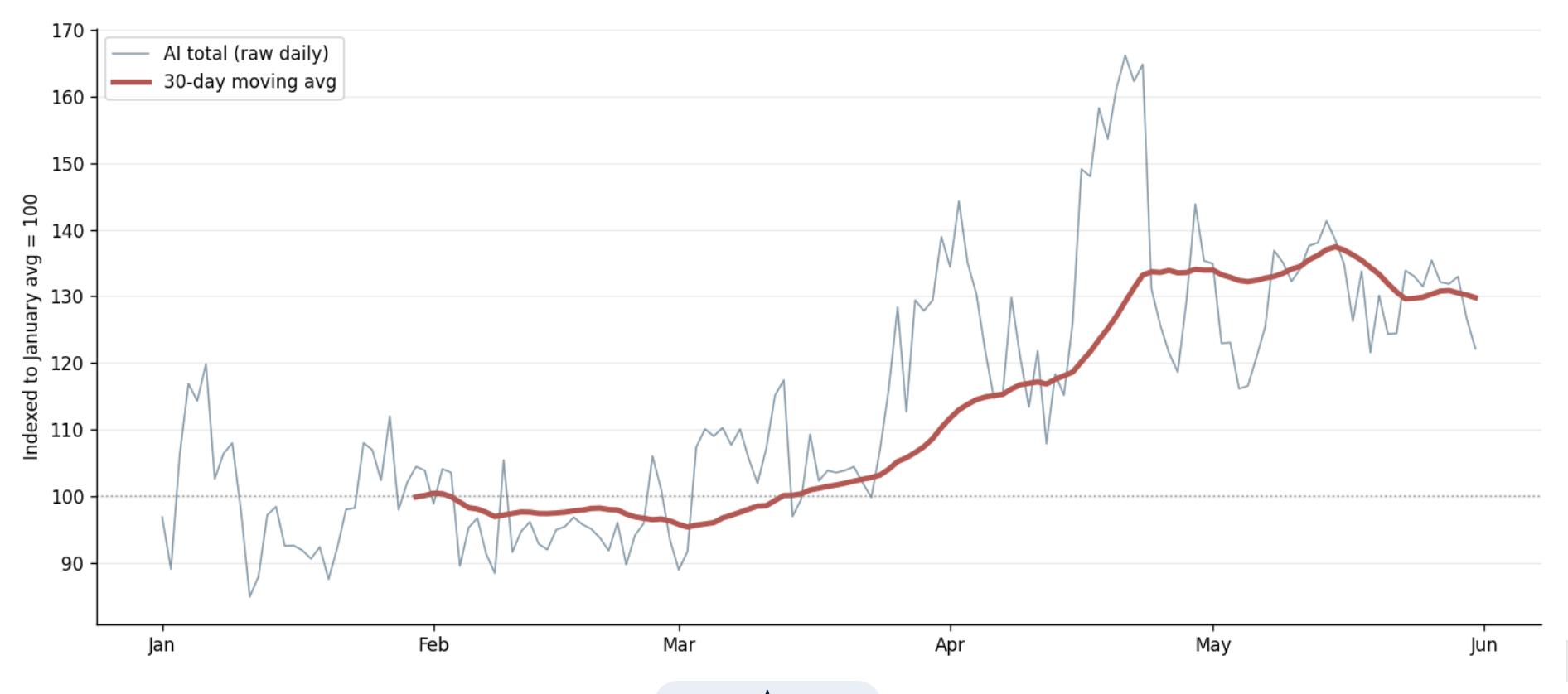
Analysis of traffic across Fastly's global network found that AI requests grew approximately 30% between January and May 2026, which is about 6.5 times faster than human traffic during the same period. While AI traffic continues to grow in importance, Fastly's research suggests the more significant shift is how AI systems interact with digital infrastructure.
The findings point to a new reality for businesses: while stopping bad bots remains important, organizations increasingly need to think and act strategically to capture the growing value from automated interactions.
Fastly's research highlights several emerging trends:
- Organizations are making increasingly strategic decisions about AI traffic management, balancing content protection, visibility, customer acquisition, and digital distribution, which can influence whether AI systems discover, reference, and surface their content and ultimately how customers find and engage with their business.
- Machine traffic now represents a significant share of internet activity, including AI crawlers, AI fetchers, bots, agents, and API-driven systems.
- AI traffic takes many forms, with crawlers and fetchers showing different patterns, purposes, and demands on infrastructure.
- AI fetchers and agents are becoming increasingly important, as AI assistants retrieve real-time information to answer questions, compare options, validate facts, and complete tasks on behalf of users.
"AI traffic is fundamentally changing how the internet operates," said Artur Bergman, Founder and Chief Technology Officer at Fastly. "Businesses are moving beyond a world where humans are the primary users of digital experiences. The challenge is no longer simply blocking bots, it's understanding which machine interactions should be accelerated, managed, challenged, or stopped."
The research also identified two distinct categories of AI traffic – AI crawlers and AI fetchers. AI crawlers systematically gather information from the web to build and update AI models, while AI fetchers retrieve information in response to specific user requests through AI assistants and emerging agentic applications. Based on May 2026 data, these workloads also place different demands on infrastructure, with more than half (51%) of AI requests requiring origin access compared to less than 9% for human requests. Fastly also observed AI traffic growing at an exceptional rate, with Claude-related traffic increasing by more than 555% compared with its January 2026 baseline.
The findings suggest that AI traffic management is evolving from a security and infrastructure concern into a broader business strategy. As organizations evaluate how AI systems interact with their content, applications, and APIs, visibility and control are becoming increasingly important.
Fastly's analysis also highlights a growing divergence in how organizations are responding to AI traffic. In one case, a large company instituted a hard block against a sudden spike in AI fetcher traffic, most likely to maintain content authority. Another large company chose not to block AI agents, resulting in an increase in fetcher volume over multiple months and potentially greater visibility with AI-powered services. These examples illustrate how decisions about AI traffic can influence not only access to content, but also customer engagement in an increasingly agent-driven internet.
The research points to three foundational elements of an effective machine traffic strategy: visibility into which AI systems are interacting with digital properties, context around how those systems behave and whether they create business value, and the precision to respond differently based on intent and impact. Fastly helps customers execute that machine traffic strategy at the edge. In the path of every request, Fastly delivers the visibility, context, and precision required to balance performance, security, bot management, and origin access with real-time intelligence.
To get more detailed insights, read our blogs at fastly.com.
About Fastly
Fastly’s powerful and programmable edge cloud platform helps the world’s top brands deliver online experiences that are fast, safe, and engaging through edge compute, delivery, security, and observability offerings that improve site performance, enhance security, and empower innovation at a global scale. Compared to other providers, Fastly’s powerful, high-performance, and modern platform architecture empowers developers to deliver secure websites and apps with rapid time-to-market and demonstrated, industry-leading cost savings. Organizations around the world trust Fastly to help them upgrade the internet experience, including Reddit, Universal Music Group, and SeatGeek. Learn more about Fastly at https://www.fastly.com, and follow us @fastly.
Forward-looking statements
This press release contains “forward-looking” statements that are based on Fastly’s beliefs and assumptions and on information currently available to Fastly. Forward-looking statements may involve known and unknown risks, uncertainties, and other factors that may cause its actual results, performance, or achievements to be materially different from those expressed or implied by the forward-looking statements. These statements include, but are not limited to, those regarding expectations regarding the future growth, velocity, and composition of AI and automated traffic; the adoption rates and scale of agentic workloads and AI assistants; the behavioral patterns of AI crawlers and fetchers; the impacts of automated requests on web infrastructure; and the performance, capabilities, and expectations regarding customer experiences with Fastly’s products and services, including Fastly Bot Management. Except as required by law, Fastly assumes no obligation to update these forward-looking statements publicly, or to update the reasons actual results could differ materially from those anticipated in the forward-looking statements, even if new information becomes available in the future. Important factors that could cause our actual results to differ materially are detailed from time to time in the reports Fastly files with the Securities and Exchange Commission (“SEC”), including in our Annual Report on Form 10-K for the fiscal year ended December 31, 2025 and our Quarterly Reports on Form 10-Q. Copies of reports filed with the SEC are posted on Fastly’s website and are available from Fastly without charge.
Contacts
Fastly Media Contact
Stacey Hurwitz
press@fastly.com
Investor Contact
Vernon Vessi, Jr.
ir@fastly.com