

Legal Nonprofit LASST and Broad Coalition Defend the Public's Right to Know What's in AI Training Data
Legal Nonprofit LASST and Broad Coalition Defend the Public's Right to Know What's in AI Training Data
The 29-member coalition of civil society groups, AI accountability organizations, public interest advocates, child safety advocates, and First Amendment scholars urges court to reject xAI's bid to strike down California's AI transparency law
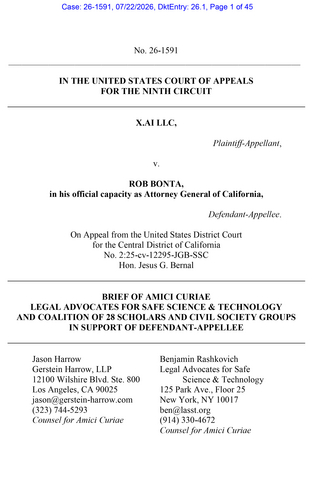
NEW YORK--(BUSINESS WIRE)--Legal Advocates for Safe Science & Technology (LASST) and a coalition spanning civil society organizations, child safety advocates, entertainment industry trade associations, AI law and policy groups, and First Amendment scholars filed an amicus brief yesterday defending California's AI Training Data Transparency Act, also known as AB 2013, now before the Ninth Circuit Court of Appeals in xAI v. Bonta.
The First Amendment should not be distorted to shield AI companies from basic product disclosure requirements that apply to every other industry.
Share
At the heart of the case is the question: does California’s run-of-the-mill product transparency law requiring that AI developers disclose high-level summaries of the data they use to train their AI systems violate the First Amendment?
xAI, owned by Elon Musk and developer of the Grok chatbot, argues that publishing even a basic summary of its training data violates its free speech rights. A federal judge in the Central District of California already rejected that argument once, denying xAI's request to block the law while the case proceeds. xAI is now appealing to the Ninth Circuit.
The coalition's amicus (or “friend of the court”) brief argues that California’s training data disclosure law is no different from requirements courts have upheld for decades: ingredient labels, country-of-origin markings, drug-interaction warnings, and other similar consumer protections. AB 2013 doesn't require AI companies to disclose source code or hand over their datasets; it requires only that companies say, at a high level, what kind of data they used and whether it includes personal information, copyrighted material, or synthetic data.
"Transparency into how AI companies develop and deploy their models is critical to public safety and a free and fair society, especially as the technology becomes more capable and more widely adopted," said Tyler Whitmer, founder of LASST. "The First Amendment should not be distorted to shield AI companies from basic product disclosure requirements that apply to every other industry."
Transparency into AI training data will help California consumers understand the products in the AI market and make informed decisions about which to use or avoid. The coalition brief details who relies on these kinds of disclosures in practice: parents trying to determine whether the AI chatbot on their child's phone was trained on harmful material, financial advisers with fiduciary duties who need to know what's inside the tools they use professionally, and businesses in regulated industries facing liability exposure from AI systems that may have been trained on data that violates copyright or privacy law.
“AI will be the most transformative technology in human history,” said Adam Billen, Co-Executive Director of Encode AI. “As its capabilities grow, basic transparency will be the foundation on which policymakers and the public keep pace with its consequences. We require this of every other industry, and the First Amendment has never stood in the way. AI shouldn’t be the exception.”
xAI has argued that consumers have no real interest in training data transparency. The size and breadth of the amicus coalition filing today suggests otherwise.
Coalition members include Alliance for Secure AI, Americans for Responsible Innovation (ARI), California Initiative for Technology and Democracy (CITED), Center for Humane Technology, Cybersafety Research Center, Digital Childhood Institute, Electronic Privacy Information Center (EPIC), Encode AI, Fairplay, David Atkinson of Future of Life Institute (signing in his personal capacity), Heat Initiative, Legal Advocates for Safe Science & Technology (LASST), NAVA, National Center on Sexual Exploitation (NCOSE), Secure AI Project, Surveillance Technology Oversight Project (STOP), Tech Equity, Tech Justice Law (TJL), Tech Oversight Project, and Transparency Coalition.
They are joined by Stuart Russell OBE FRS, Distinguished Professor of Computer Science at UC Berkeley; Lawrence Lessig, Roy L. Furman Professor of Law at Harvard Law School and founder of Creative Commons; and legal scholars Margot Kaminski (University of Colorado Law), Helen Norton (University of Colorado Law), Olivier Sylvain (Fordham Law), Kyle Langvardt (University of Nebraska College of Law), Peter Ormerod (Villanova Law), Vivek Krishnamurthy (University of Colorado), and Zephyr Teachout (Fordham Law).
The Ninth Circuit's ruling will be the first appellate decision on the constitutionality of state AI training-data transparency laws, with direct consequences for other AI transparency laws already on the books, including California’s SB 53, New York’s RAISE Act, and Illinois’ SB 315.
The full brief is available at https://drive.google.com/file/u/5/d/1nXCn6Uj8HvmYwQXf6NjyBxDIWl7BGmnI/view?usp=sharing.
About LASST:
Legal Advocates for Safe Science and Technology, Inc. (“LASST”) is a nonprofit organization dedicated to making advances in science and technology safer for people and the planet. LASST advocates for legal frameworks governing AI systems that appropriately balance innovation with security and public safety.
Contacts
Media Contact:
Amber Scorah
Email: amber@lasst.org
Telephone: (201) 448-7739